From Ritual Objects to Living Mirrors: Fab Academy Final Projects Reimagine Time, Memory, Movement, and Materiality
Fab Academy Barcelona's students presented their final projects for 2026 cycle.
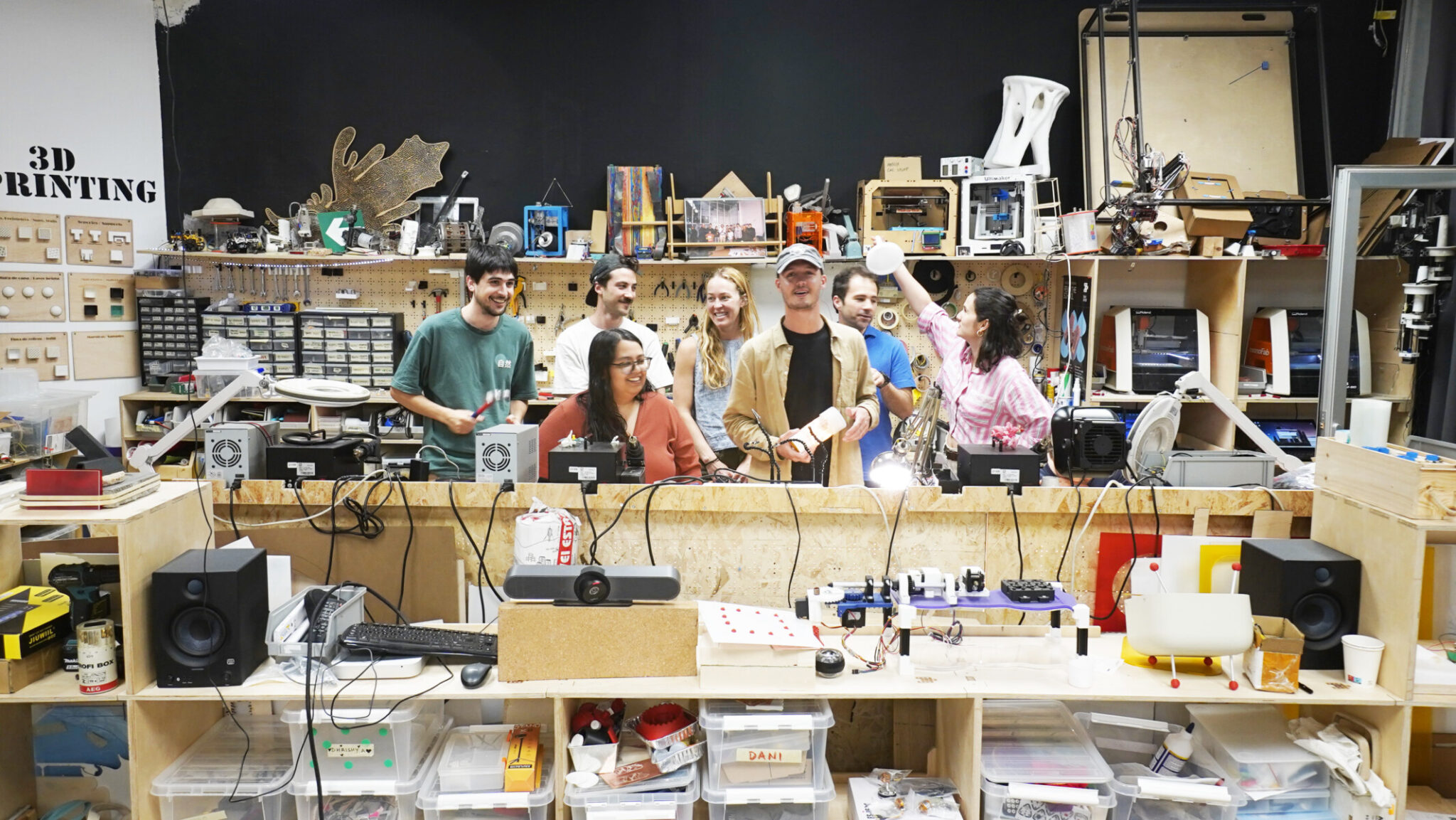
After months of designing, prototyping, debugging, milling, coding, scanning, casting, and countless hours in the lab, Fab Academy students at Fab Lab Barcelona have reached the finish line. As always, the final projects are about much more than technical achievement.
This year’s projects explore deeply human questions through digital fabrication. How do we experience time without screens? How can movement become a language? What happens when memory begins to fade? How can digital tools reconnect us with craftsmanship and materiality?
The answers emerged through a diverse collection of projects that blend technology, storytelling, interaction, and making. While each student followed a unique path, they all embraced the Fab Academy spirit of learning by doing, transforming ideas into tangible experiences.
Gabriel: A Ritual for Screenless Breaks
In a world dominated by notifications and endless scrolling, Gabriel’s Intermission Object offers an alternative: a finite, screenless break experience.
Designed as a handheld ritual device, the object uses warm light, subtle sound, gentle haptics, and tactile interaction to help users feel the passage of time rather than measure it. Inspired by Gabriel’s experience with ADHD and the ritualistic structure of a cigarette break, the project explores how physical objects can support focus, reflection, and intentional pauses without becoming another source of distraction.
Rather than counting down minutes, Intermission Object transforms taking a break into a sensory experience.
Tareq: Movement, Geometry, and Digital Craft
Tareq approached Fab Academy as a process-led exploration rather than a product-driven challenge.
Drawing inspiration from kinetic design, arabesque geometry, and traditional craftsmanship, his work investigated how movement, mathematics, and materiality can shape new forms of making. Through experiments in 3D scanning, casting, CNC machining, and material integration, he continuously moved between physical and digital worlds.
Instead of seeking a single solution, Tareq’s project became a research journey into how computational design and craft traditions can inform one another, revealing forms through discovery rather than invention.
Gennaro: Designing a Kinetic Wall
Gennaro’s final project is a kinetic wall that responds to human presence and gesture
It is motorized pin module designed as the repeating unit of a modular kinetic surface, built around a NEMA 17 stepper motor, a custom-milled PCB, and a capacitive touch sensor, with wireless communication via ESP-NOW.
Yara: A Light That Blooms
Yara’s project transforms a lighting fixture into a responsive, kinetic object inspired by a flower’s movement.
Composed of six mechanically linked petals arranged around a central shaft, the light slowly opens and closes when motion is detected. A screw-drive mechanism and repurposed stepper motor provide precise, quiet movement, while LED brightness and color respond dynamically through sensor input.
Developed through an iterative design process, the project combines mechanical engineering, electronics, and interaction design to create an object that feels less like a machine and more like a living presence within a space.
Shivangi: Reimagining Memory Through Reflection
For Shivangi, the final project became a tribute to her grandmother Maya and her experience with Alzheimer’s disease.
Maya’s Mirror is an interactive installation that gradually transforms a viewer’s reflection into flowers, vines, and botanical forms inspired by Maya’s own drawings and writings. Using sensors, generative visuals, and a custom CNC-milled frame, the project guides visitors through a journey from recognition to abstraction and finally to renewal through nature.
At its heart, the installation asks viewers to reconsider identity, beauty, and memory not as things that disappear, but as qualities that can evolve and transform.
A shout out to our students Felix Schliebitz, Pedro Rocha, Dhrishya Ramadass, and Guillermo Obregón, who will be presenting in January!
More Than a Final Project
Together, these projects demonstrate the extraordinary range of Fab Academy.
A ritual object that rethinks our relationship with time. A research-driven exploration of movement and craft. A computationally generated lighting structure. A kinetic flower that responds to human presence. An interactive memorial that transforms memory into experience. While their outcomes differ dramatically, they share a common foundation: curiosity, experimentation, and a commitment to learning through making.
Over the past months, these students have moved between code and craft, digital models and physical materials, personal stories and technical challenges. Along the way, they transformed questions into experiences and ideas into tangible forms.
The projects may be complete, but the journeys that produced them are only beginning.


