From Networks to Communities: A Reflection on GIG Week and re:publica 2026
A week of creative production, scientific innovation, and socially impactful design at GIG Week & re:publica event
Fab Lab Barcelona has been part of a network since its inception — the Fab Lab Network. That network has grown substantially over the years, driven by the democratisation of fabrication tools, the expiry of key 3D printing patents, rapid uptake by manufacturers across the globe, and the broadening interest of makers, crafters, hackers, and designers who now use these technologies for ideation, prototyping, and small-scale production. What was once the exclusive territory of well-equipped makerspaces has migrated into homes, studios, and workshops. The 3D printer is no longer a synonym for novelty keychains. Creatives are producing entire lamp shade lines on demand. In Rio de Janeiro’s Rocinha neighbourhood, makers are recycling recovered plastic waste into new filament. Projects like OpenFlexure — a 3D-printed, laboratory-grade digital microscope — have long demonstrated the technology’s potential for genuine social utility. And from the Distributed Design Platform, the collaborative work of Jessica Nissen, Patricia López, Mario García, and Ivana Llobet produced Odapt: a personalised 3D-printed wafer that addresses the practical and deeply personal challenges faced by ostomy bag users.


The maker movement, in other words, has never been static, it’s been evolving and shape-shifting. It is less homogenous than its earlier iterations. It has been evolving so far that many of its current participants would not even recognise themselves with the label “maker”, nor are they necessarily aware of the movement’s history or infrastructure. That is not a weakness; it is a sign of diffusion. This makes clear that the movement was never truly bound to the makerspace, despite how it has often been framed. In our eyes it can be better understood as an attitude; a disposition towards making, sharing, and iterating, manifesting across a wide and loosely connected web of communities, with clusters, overlaps, and gaps. Which over time had tears in some places and grew in others.
Accordingly, the maker movement is no longer represented by a single network. Vulca, RFFLabs, GIG, the Fab Lab Network, the Ukrainian Makers Association, Distributed Design just to name a few, are all regional structures or global representations of makers. Some thematically focused and others broadly scoped. Many practitioners belong to more than one network. What is less often acknowledged, however, is the distinction between what these structures are — networks — and what many of them are quietly becoming, or perhaps always were at their core: communities. The two are not the same, and the difference matters. But before expanding on that, it is worth grounding these reflections in something concrete.
GIG Week: Crisis-Resilient Community Innovation
The GIG Week is a co-design programme organised by and for GIG members, running in parallel with the re:publica festival — itself now more than a decade old. This year, the first two days brought the GIG community together at the Berlin Global Village for an intensive programme of workshops, talks, shared meals, and informal exchange. The format resists the logic of the conventional conference. Knowledge circulates without the usual gatekeeping; there are no keynotes that consolidate authority at the front of the room. People share what they are working on, what they are struggling with, what is currently preoccupying them. Expertise is distributed, and so is the responsibility to contribute.


What becomes apparent in these settings is something that is genuinely difficult to manufacture: a culture of reciprocity. People give! Time, knowledge, attention, without transactional expectation. The informal phrase “the cosmic bank will balance things out” captures something real about how trust operates in communities of practice over time.
One of the more structurally significant moments of the two days was the GIG Fund, a participatory grant-making mechanism developed collaboratively by GIG members themselves. The fund is notable not just for what it funds, but for how it operates: governance was co-designed by the community, and voting rights sit with the members rather than with external evaluators. This is a meaningful inversion of the typical model, in which legitimacy flows from institutional distance rather than embedded knowledge. The community, in this case, is trusted to know what is worth supporting. It is a modest but important precedent.


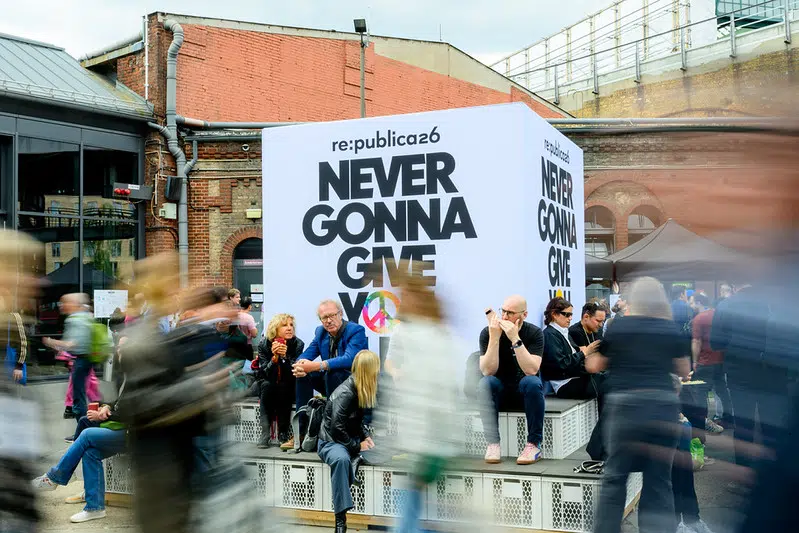
re:publica 2026: “Never Gonna Give You Up”
The broader re:publica festival reflected the weight of the current moment. AI dominated the agenda, and a significant portion of the programming navigated difficult terrain, the erosion of democratic norms, the acceleration of surveillance, the compounding crises that increasingly define public life. For many attendees, sustaining hope required conscious effort.
The makerspace corner offered a different register. Where much of the festival was discursive, here things were being made. Repair, fabrication, and collective practice occupied the same space as critical conversation, and the juxtaposition was instructive.


The EU-funded make-a-thek project hosted a Textile Bar where visitors could repair clothing, make quilt patchworks, and learn about the project’s recently launched bus tour. Jessica Guy, Distributed Design lead at Fab Lab Barcelona, ran an interactive installation built around a single question: what was your first making experience? Visitors drew their responses directly onto a large shared textile, then embroidered them. The resulting collage is a slow, cumulative record, stories preserved in thread rather than data. The work was conceived partly in anticipation of Fab Lab Barcelona’s upcoming twentieth anniversary, and the textile will continue to travel, gathering more contributions before being exhibited as part of those celebrations.


Jessica also facilitated an artivist zine-making workshop. In under an hour, more than twenty-five people occupied a few square metres with paper, pens, scissors, and a prompt: what makes you really mad lately? The session drew on the history of zines as a form of accessible, lo-fi political expression, and the work produced was accordingly direct.


A panel discussion “From Maker Faires to Social Infrastructures” brought together Barbora Pesek from Make More, Fadia (community manager at GIG), and Jessica to examine how the networks that grew up around events like Maker Faire have changed. The conversation covered structural challenges, the difficulty of sustaining momentum, and the more existential question of why people continue to do this work at all. The answer, broadly, was passion: with all the precarity and purpose that word carries. These are not, for most people, simply jobs. They are commitments shaped by a conviction that the work matters: that every shared file, every collaboratively developed project, every object produced and given away is a small act of prefiguration. A prototype, in the fullest sense of the word, of something not yet fully realised.

We are not merely participants in networks. We are members of communities and that distinction, however subtle it may appear, carries real consequences for how we organise, how we sustain one another, and how we understand the value of what we do. The horizon is uncertain. But the capacity to act collectively, to make things together, and to insist on a different set of priorities remains. We look forward to the next gathering and to continuing to prototype, in practice, the futures we want to see.