RED&Pro | Regenerative Ecologies of Design and Production
RED&Pro brings together designers, producers, communities, and institutions to explore regenerative forms of design practice. The project seeks to reframe design as a situated ecological and cultural practice, moving beyond sustainability towards approaches centred on living systems and reciprocal relationships.
The Challenge
Europe’s design sector operates in a fragmented landscape, with a workforce underprepared for green and digital transitions, lack of valorisation of traditional and ancestral crafts, weak cross-sectoral connections, and production models locked into linear, resource-intensive paradigms that contribute to ecological degradation, cultural homogenisation, and social inequality.
Our Solution
RED&Pro aims to establish a European regenerative design framework that brings together ecological regeneration, social participation, and economic resilience. Through experimentation in six bioregional labs, the project will develop evidence, methodologies, and practices that can be shared through distributed educational models and open digital infrastructures, supporting the broader uptake of regenerative practices across the globe.
Type of Project
HORIZON-CL2-2025-01-HERITAGE-06.
“Europe as a global powerhouse of design for sustainable competitiveness,” it focuses on maximizing the impact of European design, craftsmanship, and creative traditions to boost environmental sustainability and market competitiveness.
Project Outputs
-Regenerative Design Framework with practitioner blueprints
-Hybrid Design Academy including 18 Educational Micro Modules
-Digital Regenerative Design Repository (git-based versioning + Digital Product Passports + AI powered material intelligence)
-6 pilot case studies with Research-through-Design artefacts developed
-Policy White Paper and briefs on regenerative design and bioregions
The Project
Design is rarely neutral. From the objects we handle daily to the infrastructures we collectively inhabit, it operates as a carrier of identity, heritage, and systemic power — shaping not only how things look and function, but how societies organise themselves and relate to the material world. Yet across Europe, the design sector remains structurally fragmented, its workforce underprepared for the demands of ecological and digital transition, and its production models still largely locked into linear, resource-depleting paradigms.
RED&Pro is a 36-month Horizon Europe research and innovation project that takes this condition as its starting point. Rather than proposing incremental improvements, it advances a substantive shift: from sustainability as a baseline standard towards regenerative design as a new cultural orientation — one that places ecological restoration, social equity, and heritage knowledge at the centre of design research and practice. Its methodological foundations draw on Research through Design and Commons-Based Peer Production, treating the act of designing not merely as professional output but as a mode of inquiry capable of generating knowledge, challenging norms, and producing durable change.
The projects objectives are to:
- Design, Validate and make accessible a Regenerative Design Framework that leverages an inclusive, interdisciplinary, heritage-driven approach in local design and production ecosystems.
- Support the emergence and cultivate hybrid design professionals by equipping them with future-proof skills that bridge environmental care, cultural sensitivity, and emerging technologies to build the next generation expert workforce to drive innovation and tackle Europe’s next decade’s challenges.
- Prototype bioregional regenerative design and production hubs (RED-Labs) as living laboratories for education and professionalisation to foster a shift toward prosumer-based models that stimulate designs that are socially, ecologically, and economically sustainable and scalable.
At the heart of RED&Pro are six experimental RED-Labs, place-based and bioregional production ecosystems located in Denmark, Spain, Italy, the Netherlands, Slovenia, and Ukraine. Each lab pairs an urban design hub with a rural, nature-based partner, exploring what circularity, material reuse, and bio-based sourcing can look like across the whole value chain in each respective context; learning from one another and identifying the particular potential of each.
The Regenerative Design Framework, developed through and validated by these pilots, will be codified into the Hybrid Design Academy: a capacity-building programme for practitioners, educators, and institutions. Alongside this, a federated open-source Regenerative Design Repository will integrate material intelligence tools to make regenerative practices transparent, traceable, and replicable at scale.
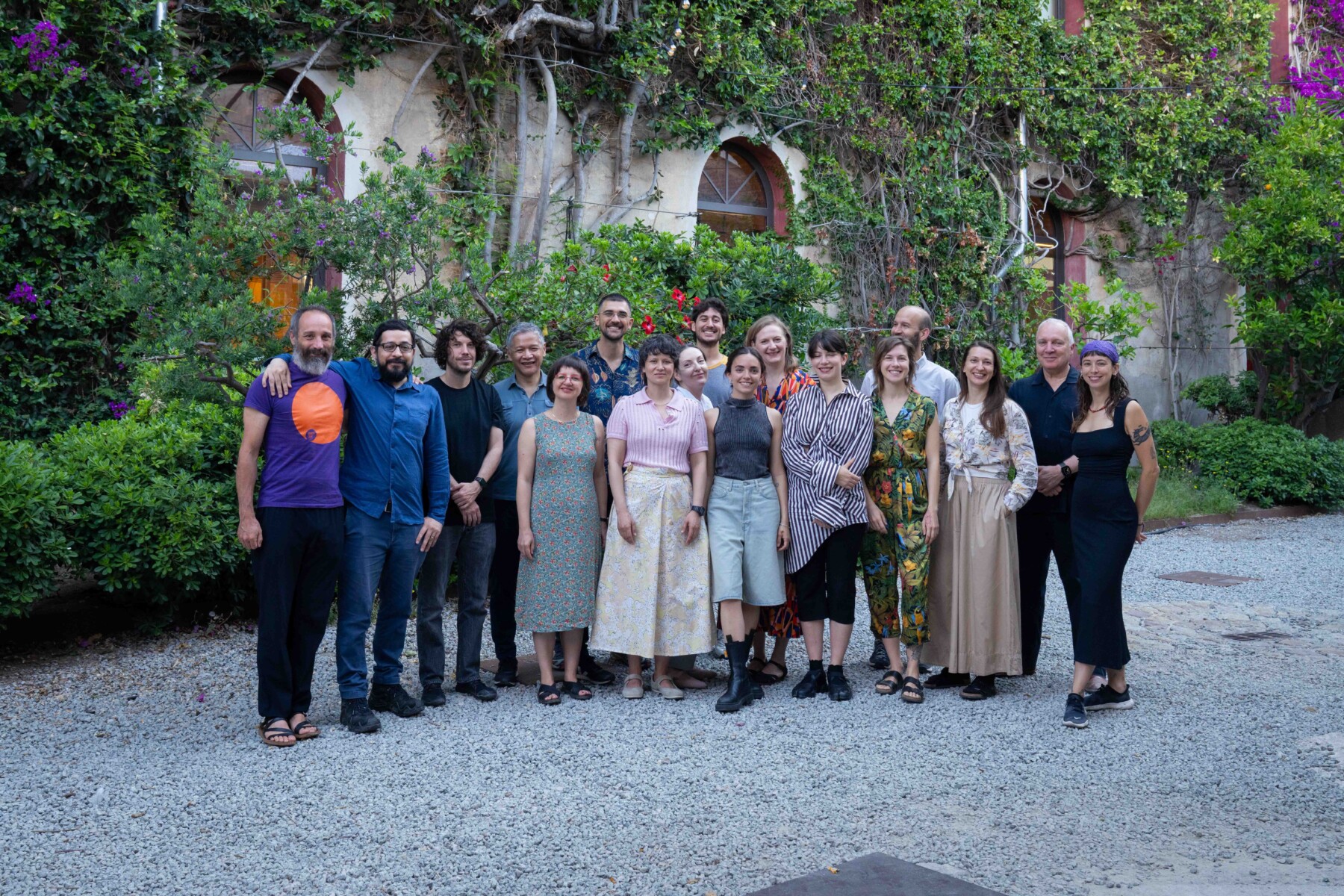
RED&Pro is coordinated by Fab Lab Barcelona at IAAC and brings together 13 partner organisations across nine countries: TU Eindhoven, Simon Fraser University, the New Production Institute at Helmut Schmidt University, Maker Copenhagen, OpenDot Foundation, Center Rog, Metalab, EIT Culture & Creativity, Spot Materials, designaustria, FutureDays, and Here Partners.
Funded by the European Horizon Europe programme under grant agreement No. 101286792.
Our Contribution
As project coordinator, Fab Lab Barcelona (IAAC) is responsible for overall project management, financial administration, and liaison with the European Commission. Beyond its coordination role, IAAC participates directly as one of the six pilot sites, contributing deep expertise in design research and process, whilst strategically positioning its existing platforms and tools (including the Distributed Design Learning Hub) for further development and broader exploitation across the project’s lifetime. The Fab Lab Barcelona team also contributes to the technical development of the Regenerative Design Repository, and plays a central role in connecting RED&Pro to the wider Fab Lab and Maker Movement ecosystem.
Who is it for?
Designers, makers, and creative practitioners seeking regenerative skills and tools; educational institutions looking to integrate regenerative design curricula; creative hubs, makerspaces, and fab labs piloting new production models; SMEs and cultural industries transitioning toward circular, heritage-rooted value chains; and policymakers shaping EU strategy on the creative economy and green transition.
Our Consortium
Coming soon…
