
Who gets to decide when a machine is obsolete?
Obsolescence is a decision, and it is made a long way from the person who owns the machine. A few people are now using language models to contest that decision. We want to take them seriously without swallowing the sales pitch that comes attached.
A 1994 Jeep, an orphaned audio interface, a film scanner nobody supports. People are using language models to pry abandoned hardware back open. None of these machines was broken. So who decided they were finished?
In November 2026, a 1994 Jeep Cherokee passed California’s smog test. It had been failing on nitrogen oxides, and the car predates the OBD-II port, so no ordinary scan tool could talk to its engine computer.
Its owner, Muhammad Zulali, wired a $3 Arduino Nano to three pins of the diagnostic plug and pointed Claude Code and GPT Codex coding tools at whatever came out. A week later he had a copy of the computer’s program, a culprit and, by his own account, a pass.
The tech press filed the story under “look what AI can do”. That is the least useful way to read it.
No part had failed. What stood between the owner and the fix was a protocol nobody had documented for him and a diagnostic tool nobody sells any more. Machines rarely die of hardware failure. They die when someone withdraws the driver, the documentation or the permission. Obsolescence is a decision, and it is made a long way from the person who owns the machine.
A few people are now using language models to contest that decision. I want to take them seriously without swallowing the sales pitch that comes attached.
When did we stop owning our things?
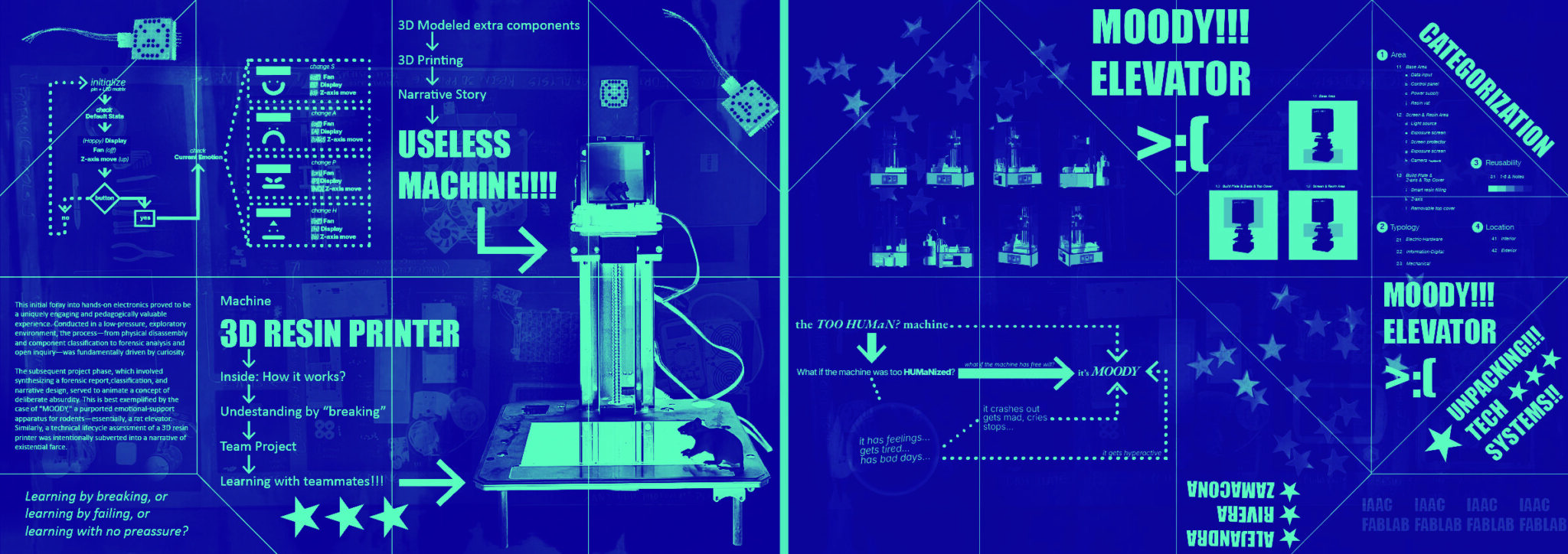
At Fab Lab Barcelona, we have spent years asking why objects become obsolete long before they stop working. In workshops such as Unpacking Tech Systems and The Almost Useful Machines at the Master in Design for Emergent Futures, students dismantle discarded electronics and write forensic reports on what makes them so hard to repair.
The reports keep finding the same thing. One dead component, one discontinued app or one withdrawn manual is enough to make replacing the whole product cheaper than fixing it. That is a design outcome, not an accident. The UN’s Global E-waste Monitor 2024 counted 62 million tonnes of e-waste in 2022, with only 22.3% documented as properly recycled.
The EU’s Right to Repair Directive, which Member States had to apply from July 2026, helps. But a directive cannot recover decades of lost technical knowledge.
Meanwhile, the AI industry asks for more of everything: more computation, more data centres, more energy, more hardware churn. That makes it an unlikely ally for anyone who wants things to last. The cases below turn its product against its logic.

Reverse engineering, pointed at the scrapheap
Audio interfaces without drivers. The Avid Mbox Pro 3 lost manufacturer support years ago. In August 2026, a developer used Claude to write a driver for Apple Silicon Macs. The hardware protocol had already been documented by the Linux community, so the model translated existing work. Joren Six did the same for an M-Audio FastTrack Pro, restoring 24-bit audio, MIDI and S/PDIF input. Neither device had failed. Both had been demoted by a software ecosystem that moved on without them.
A scanner with the wrong chipset. Christian Schaller bought a Plustek OpticFilm 8200i that turned out to be unsupported on Linux. He captured USB traffic from a Windows virtual machine and used Claude Code to work through it until he had a driver. The model sifted captures and drafted tests. Schaller decided what to investigate and checked what the hardware actually did. Then he learned that another developer had independently solved the same scanner. The model did not replace collective knowledge. It duplicated a piece of it.
A Jeep with a hidden calibration. In Zulali’s Cherokee, the memory dump revealed a California-only fuel calibration that cut fuel at the very load used in the smog test. Now the small print. The parameter tables came from an open-source project, and one did not match this car: an early reading had the engine adding fuel when it was removing it. The result is self-reported, on one vehicle, by an owner who says he is not a mechanic. To his credit, he published everything as xj-scanner under GPLv3.
A printer and a monitor. The HP Laser 1008a shipped in 2023 with no macOS driver. The fix a developer published was, as first reported, HP’s own Linux codec running in a container. HP had the software all along. And when security engineer Chaz Schlarp turned a model on the firmware of his nagging ASUS monitor and four other peripherals, he found he could switch off his webcam’s recording light while it kept filming. The method that frees a device from its maker opens it to everyone else.
None of this makes reverse engineering effortless. An enthusiast who patched a tablet’s BIOS with ChatGPT was one wrong byte from a brick. What the models compress is the tedium. That is the only claim these cases support.
Retrofitting rather than replacing
Retrofitting goes further than repair: it gives old hardware new capabilities. The Ritual brings film simulations to twenty-year-old Canon EOS 5D cameras. Sprout is a replacement mainboard for classic iPods that adds Bluetooth and USB-C. I have no evidence that a language model touched either project, and that is why they belong here. The shift consists of treating an old object as a platform to adapt, not a product frozen on the day of purchase.
Several of these cases come from music and photography. Nicholas Negroponte once told me how hard architects pushed the early development of computer-aided design. Practitioners have shaped computing, not just received it.

What a Fab Lab adds that a chatbot can’t
None of these cases removed the human. Each needed someone who knew what to measure and what to doubt, a bench with the right instruments, and somewhere to publish the result. The know-how existed all along. What was missing was a reason to spend it: weeks of expert work to rescue one scanner never paid back.
That is what has changed. With a model absorbing the drudgery, a repair nobody could justify becomes worth attempting. And the fix only has to be found once. An alternative firmware written for one machine can rescue hundreds like it from obsolescence, with no model involved. It is a far better use of these tools than vibe-coding narcissistic creations.
Reverse engineering has always been rare in Fab Labs. The learning curve was steep and people found it intimidating. We hope these tools break that barrier, because labs no longer have a reason not to do it. They already have the instruments and people who understand hardware. They can be the place where anyone’s abandoned scanner, audio interface or camera gets reopened, checked and documented for the next owner.
Our own machines are the first test. A working laser cutter whose driver only runs on Windows XP, or a second-hand KUKA arm locked behind an old controller, is the same problem at home. They also show the limit: a bad audio driver produces silence, a bad robot controller produces an injury.
The right to repair is not the capacity to repair
A right to repair means little without the capacity to exercise it. Products are designed so that dependency outlives the sale. We own the object. The manufacturer keeps the software, the documentation, the spare parts and the permission.
Even that permission is provisional. In the EU, Article 6 of the Software Directive allows decompiling only for interoperability, and restricts passing on what you learn. In the United States, breaking a digital lock to repair your own device is legal through temporary DMCA exemptions that expire in October 2027.
Here is the trap. If keeping a machine alive requires a monthly payment to a proprietary model in someone else’s data centre, nothing has been reclaimed. The landlord has changed. Whatever is recovered has to stay understandable, verifiable and openly shared. Otherwise it has not been recovered.
Closed source is dead. Open source may be next.
If a hobbyist with a USB capture and a language model can reconstruct a protocol in a week, secrecy no longer works as a lock. Closed source, as a way of controlling what owners do with their hardware, is finished.
The open-source world should hold the celebration. The same models were trained on public code, mostly without credit. And when anyone can generate a private, one-off driver, fewer people have a reason to join a project or review a patch. Open source was never only readable code. It was people maintaining things together, and a text generator does not reproduce that.
Build the tools, don’t rent them
So I am not proposing that Fab Labs buy subscriptions to Claude or ChatGPT and call it a repair strategy. The better questions are harder. Can useful models run locally, on hardware we already own? Can what these experiments produce become a shared resource?
Permacomputing rejects the assumption that progress requires ever more computation and constant hardware replacement. Exo Labs builds open-source tools for running models locally, and once ran a small language model on a Pentium II under Windows 98. It was a demonstration, not an alternative, and local does not mean sustainable. But it punctures the idea that this work must begin with the newest hardware.
Distributed design should include what already exists
Through the Distributed Design Platform, we have argued for years that data should move and products should not. The same applies to maintenance: repair knowledge, alternative firmware and compatible drivers can circulate the way designs do. It is also part of what RED&Pro, the Horizon Europe project coordinated by Fab Lab Barcelona, means by regenerative production.
Ownership should mean more than permission to use something until its manufacturer decides otherwise. It should include the practical ability to understand it, repair it and decide how long it stays useful.
A revived audio interface and a Jeep that passes smog will not fix the environmental cost of our technological systems, and the models used to get there carry costs of their own. But these cases prove one thing. The line between a working product and an obsolete one is drawn by whoever holds the knowledge needed to make the thing run.
So here is a place to start: a public register of orphaned devices, open to anything people bring into a Fab Lab, each listed next to whatever has been recovered for it. At Fab Lab Barcelona, we will start with our own machines and open it to yours.
The alternative is already on offer: the ability to keep things alive, sold back to us as a subscription.
If you want to explore these questions hands-on, join us at the Master in Design for Emergent Futures (MDEF).
Article by Guillem Camprodon